No place on earth compares to this vast wilderness of elemental forces: snow, ice, water, rock. Antarctica is simply stunning.
Adventure…Antarctica’s surreal remoteness, extreme cold, enormous ice shelves and mountain ranges, and myriad exotic life forms invariably challenge you to embrace life fully. Everyone – scientist, support worker, government official and tourist – who comes to this isolated continent, must ‘earn’ it, whether by sea voyage or flight. Ice and weather, not clocks and calendars, determine the itinerary and the timetable of all travel here. Today, it’s even possible for visitors to climb Antarctic peaks or kayak icy waters. But there is nothing quite like the craggy crevasses of a magnificent glacier or the sheer expanse of the polar ice cap.
Wildlife…Preserved by the Antarctic Treaty, Antarctica is home to some of the world’s most extraordinary species. Some, such as the enormous whales, migrate from afar, while others, including the Weddell seal and emperor penguin, remain close to the continent. Millions of seabirds skim the Southern Ocean, the world’s most abundant, and species such as albatrosses and petrels circle the waters. Wildlife is generally unafraid of humans: visitors usually elicit no more than an uninterested yawn from seals and penguins focused on their young.
History…The names of explorers and their sovereigns and benefactors are written on Antarctica’s shores. Renowned explorers from Cook to Amundsen and Scott all tried to penetrate this vast, mysterious land: each with varying degrees of success. Visitors can follow in their footsteps and imagine what it was like to forge through the pack ice on a creaking wooden boat or to haul sledges across the polar plateau. Some of the historic huts actually remain, preserved frozen in rime ice, to tell the story of adventures long past.
Inspiration…Antarctica possesses an unnameable quality. Call it inspiration, call it grandeur…it is simply the indescribable feeling of being a small speck in a vast, harshly beautiful land. A land where striated ice towers float among geometric pancake ice, literally untouched mountains rear from marine mist, and wildlife lives, year in and year out, to its own rhythms, quite apart from human concerns. To let our minds soar in a place nearly free of humankind’s imprint: this is magic.

Depart Australia/New Zealand in your selected airline.
Upon arrival in Buenos Aires (Argentina) clear Customs and Immigration before meeting your guide. A private vehicle transfer to your hotel. Check-in with the remainder of the evening at your leisure.
Overnight: Alvear Palace Hotel, Buenos Aires

Breakfast this morning at your hotel.
Check-out after breakfasting this morning for your transfer to Buenos Aires Airport.
Aerolineas flight AR1886
11:05 Depart Buenos Aires Economy Class
14:45 Arrive Ushuaia
Duration: approx. 3hrs 40mins
Arrive Ushuaia, meet and greet and transfer to your hotel
You will begin your journey in Ushuaia, a small bustling port town at the tip of South America. This Argentine town is the gateway for you to explore the southern extent of Patagonia while preparing for your adventure ahead. Enjoy the mountains or sample handcrafted chocolate at a café in town.
This evening, we all gather for a welcome dinner at a local restaurant.
Overnight: Albatros Hotel, Ushuaia
Breakfast this morning at your hotel.
Today is at your leisure to explore Ushuaia…undertake some of the optional activities or laze around and enjoy some shopping!

Enjoy a trip on the Fin del Mundo train
The ‘train of the end of the world’ or Tren del Fin del Mundo is what the Ferrocarril Austral Fueguino (Southern Fuegian Railway) is commonly called.
The train has historical links to the prison that used to house inmates at the end of the world, but you’ll learn more about that by taking a ride on the train itself. It’s been a tourist attraction since 1994 and does a great job at combining history with the incredible scenery of this remote train route.
The entire trip is only 7 kilometres (4.3 miles) and ends at Tierra del Fuego National Park. You can opt to stay once you reach the national park station if you wish to use this as a means of transportation to visit the park, or you can head back the same day.
Along the train journey, you’ll hear the story of the train’s history and see incredible scenery including the Macarena waterfall. It’s a relaxing and rather short tour, but worth it!
Drink Craft Beer
When you’ve had enough of running around sightseeing or doing snow sports of your choice, you may want to kick back and grab a beer.
There are local craft breweries like Cerveceria Grut ’84 and Van Gogh Beer House that serve as great places to meet other travellers, learn about the area and the history of Ushuaia, or just hang with friends and get a little tipsy (no judgment here!).
Many of the breweries are located along the main strips in town, near other restaurants and shops. You can easily get to any of these spots to try some local beers and get another taste of Ushuaia’s food and drink scene.
We meet this evening for a short walk to our Welcome Dinner venue.
Overnight: Albatros Hotel, Ushuaia (in conjunction with Antarctica cruise)

Full day – crossing the Drake Passage
These two days are spend crossing the Drake Passage.
Your days at sea are filled with presentations led by your Expedition Team who will prepare you for the wildlife, glaciology and history that will greet you upon your arrival. In between presentations, spend time on deck looking for wildlife or chatting with your shipmates over a drink at the bar.
The infamous Drake Passage extends about 1,000 km (600 miles) between Cape Horn, on the tip of South America, and the South Shetland Islands. Crossing the Drake is a rite of passage for polar travellers. The channel, especially when the waves are high, is called the “Drake Shake.” (Conversely, when it’s calm, it earns the nickname “Drake Lake.”) The huge swells that arise in the Drake Passage are the result of cold seawater from the south colliding with the warm seawater from the north, which results in powerful eddies.
Crossing the Drake can take up to 48 hours and temperatures range from 5°C in the north to -3°C in the south. A good pair of eyes – or a strong set of binoculars – is handy to spot whales (humpback, orca, minke and fin) and seabirds (albatrosses, petrels, shags, skuas, and gulls) during the crossing.
Enjoy lunch and dinner on board…including all day refreshments, tea and coffee.
Overnight: Drake Passage, aboard the Ocean Explorer

Full day – South Shetland Islands and Antarctic Peninsula
The most common reaction upon reaching the White Continent is a sense of reverence and awe. The experience is beyond words, since few places are as untouched and enduring as Antarctica. You will begin to appreciate why this region has long captivated the attention of explorers and travelers alike. Every time we visit Antarctica, we witness something new or unexpected, which means that your expedition will be unlike any other - creating a unique, personal experience.

Aitcho Islands
This group of small islands is situated in the northern entrance of the English Strait. You can often spot a great mix of wildlife in the area, with gentoo and chinstrap penguins having established rookeries on the islands. Southern elephant, fur and Weddell seals frequently haul out here, too.
Deception Island
Deception Island is a flooded circular caldera formed by the collapse of an active volcano. To reach this protected harbor, it is necessary to sail through a narrow passage called Neptune’s Bellows. Inside are several bays used at various times for whaling and scientific research. Along with waddling penguins and lounging seals, you’ll see the rusting remains of whaling operations on the beach in some locations. The landscape of Deception Island often presents opportunities for longer walks to striking vistas. The stark contrast between snow and dark volcanic sand and the steam along the shoreline from geothermic activity when the tide is right, gives this location an atmospheric feel.
Half Moon Island
This crescent-shaped island was known to sealers as early as 1821. While they tried to keep this productive location secret, we’re happy to bring you ashore on this impressive island. Many Antarctic birds breed here, including chinstrap penguins, shags, Wilson’s storm petrels, kelp gulls, snowy sheathbills, Antarctic terns and skuas.

Turrett Point
Chinstrap and Adélie penguin rookeries are found on this point, situated on the south coast of King George Island. The beaches here are often crowded with southern elephant, fur and Weddell seals hauled out on the rocks.
Yankee Harbour
Gentoo penguins have established a rookery at this harbor, situated on the southwest side of Greenwich Island. Here, you can see an abandoned Argentine refuge hut and a large glacier that stretches along the east and north sides of the bay. An abandoned sealing try pot is all that remains of the activity that brought men thousands of miles in tall ships to seek their fortune. Enjoy a rare chance for a longer walk along the expansive beach, dotted with historical artifacts and wildlife.
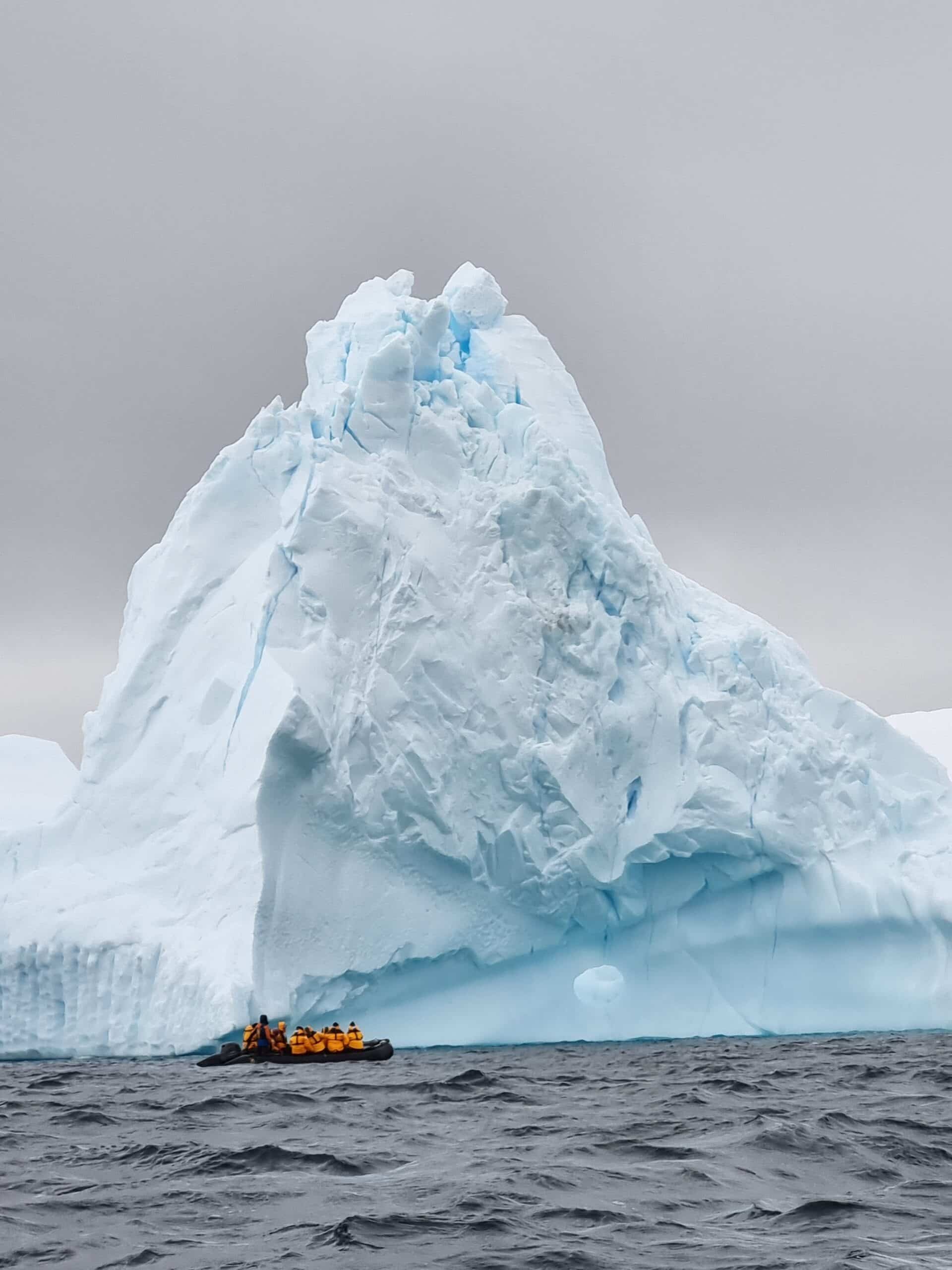
Each day, you will take Zodiac excursions from the ship to explore glaciated bays, channels and landing sites. Your Expedition Team will take care of you at each landing, whether you are hiking the Antarctic landscape, visiting a research station or consorting with chinstrap, Adélie and gentoo penguins, all of which can be found here. Keep an eye out for Weddell, fur, crabeater and leopard seals as well as curious whales, such as humpbacks, minkes, or perhaps orcas while on a Zodiac cruise. Each excursion will present a new collection of creatures to delight you and keep your camera busy.

Cierva Cove
If one of your expedition goals is to witness jaw-dropping icebergs and giant sea ice, Cierva Cove will not disappoint. A massive glacial face regularly calves into the bay, leaving often spectacular floating ice. Seals can be spotted on ice floes, and later in the season, humpback whales occasionally feed in the icy waters.
Cuverville Island
Rising out of the mouth of the Errera Channel, this tall, steep island is covered by a colorful spectrum of lichens and mosses. A large gentoo penguin rookery is situated on a rocky beach at the north end of the island. Depending on when in the season you arrive, you may see the penguins building nests, incubating eggs, or attending to their chicks.
Damoy Point
Damoy Point is the site of a historical ice runway used by the British Antarctic Survey for their flights further south since 1975. The well-maintained hut was used as a staging-post to store supplies and for accommodation while awaiting ideal flying conditions. The point is also home to a penguin rookery and allows for spectacular views of the mountains of Anvers Island.
Amid the serene silence of Antarctica, noisy interludes become indelible memories, such as penguins squabbling over prized pebbles, or the boom and crack of a calving glacier.

Danco Island
Home to gentoo penguins, this small dome-shaped island provides you with a stunning view of the Errera Channel.
Enterprise Island
Located in Wilhelmina Bay, this island’s protected coves were once used by whalers. A Zodiac cruise exploring the island passes the rusting remains of a wrecked whaling ship and provides opportunities to search for humpback whales.
Lemaire Channel
One of the most scenic locations on the peninsula’s west coast, this dramatic strait runs between Booth Island and the Antarctic Peninsula. The channel may become impassable when ice fills the narrow, 6.8-mile (11 km)-long passageway, so we’ll hope for clear waters.

Melchior Islands
This group of low, glaciated islands in Dallmann Bay is where you may see hauled-out male fur seals.
Mikkelson Harbour
Located on the south side of Trinity Island and surrounded by ice cliffs and reefs, Mikkelsen Harbor is a 1.86-mile wide bay, discovered by a Swedish Antarctic expedition in 1901-04. Enjoy a Zodiac cruise of the beautiful waters, or if conditions allow, land at D’Hainaut Island, home to an Argentine refuge and whaling remains in the form of a wooden boat and whale skeletons. Weddell seals are often seen in the area and a gentoo penguin rookery is situated on the island.
Neko Harbour
Little evidence remains that this bay was once used by the floating whale factory ship Neko. You might see whale vertebrae being used by resident gentoo penguins as shelter from the wind. Climb up a steep slope for spectacular views of the glacier-rimmed harbour.
Paradise Harbour
Paradise Harbor is a wide bay and natural harbour on the West Antarctic Peninsula. Mountains, glaciers and ice cliffs offer spectacular views. Icebergs occasionally calve from the glaciers, providing a place for seals, penguins and seabirds to rest and play. An Argentine research base, Almirante Brown Station—named after Admiral Guillermo Brown, father of the Argentine Navy—is also located in Paradise Harbor, and was operated from 1951 until a large section of it burned down in 1984. It has since been partially rebuilt and today is used during summer months for scientific research.
Petermann Island
Here, near the Lemaire Channel, you can stand ashore and see the southernmost breeding colony of gentoo penguins. Adélie penguins, shags and south polar skuas also inhabit the island.

Port Lockroy
As part of Operation Tabarin during the Second World War, a secret British base was built in this sheltered harbour, located on the west side of Wiencke Island. Now a designated historic site, the base is a museum and post office. Proceeds from your purchases in Port Lockroy support the UK Antarctic Heritage Trust, which preserves British and other historic sites dating to the Heroic Age of Exploration. A large gentoo penguin population resides here.
Wilhelmina Bay
Humpback whales abound in “Whalemina Bay,” as it’s nicknamed, and the scenery is spectacular. Sheer cliffs and glaciers surround the calm waters of the protected bay, named after Wilhelmina, queen of the Netherlands from 1890 to 1948. If you’re lucky, you may see the humpbacks bubble-net feeding: they exhale while swimming in a wide circle below the surface, trapping krill in a “net” of bubbles, and then swim straight up from below, mouths open, to engulf their prey. A truly astounding sight!
Every day will be different, having been carefully crafted by your Expedition Team to inspire and educate you about this wonderful part of the world.
Overnight: Antarctic Peninsula, aboard the Ocean Explorer

Full day – crossing the Drake Passage
Your final two days are spend crossing the Drake Passage.
The journey back across the Drake Passage provides final opportunities to enjoy the crisp Antarctic air. Spend time on the deck, watching for seabirds and scouting for whales, enjoy presentations by your Expedition Team and celebrate the experiences shared exploring Antarctica.
Enjoy lunch and dinner on board…including all day refreshments, tea and coffee.
Crossing the Drake is a Rite of Passage…
When people return from Antarctica, they tell the story of their Drake Passage crossing, almost the same way some mothers describe childbirth or distance runners tell of their first big race. Beyond the bragging rights, those who have crossed the Drake know they have completed something difficult and special—a feat that results in lifelong dividends.
In crossing the Drake passage, you will have journeyed across one of the planet’s roughest sections of ocean, followed by the awesome reward of experiences in Antarctica.
Not everyone has the mettle to pay that price. Few travelers visit Antarctica—only about 40,000 each year.
That’s an exclusive club, and the Drake is the main mental obstacle to greater visitation.
Crossing the Drake is a self-selecting filter - if it were easy, everyone would do it.
Overnight: Drake Passage, aboard the Ocean Explorer

Morning – arrive Ushuaia
Arriving into Ushuaia this morning…disembark and meet your guide and transfer into town for some free time. Meeting at a central location around lunchtime, a private transfer has been arranged to Ushuaia Airport for flights home.

Ocean Explorer is modern, elegant and purpose-built for polar exploration. The 138-passenger vessel has been designed with the latest in expedition ship technology. One of the ship’s key features is the ULSTEIN X-BOW®, a marine engineering innovation that ensures a comfortable and smooth sailing experience thanks to the inverted bow. Located at the bow is the two-story, light-filled library, which introduces a welcome airiness to the expedition ship.
Spacious cabins feature a modern, bespoke Scandinavian design and almost all have verandas. Guests can relax and find comfort in the spacious gym, sauna with large windows, and two outdoor Jacuzzis.
Ocean Explorer features ample outdoor viewing areas and multi-height outer decks, which are ideal for long-view photography and wildlife viewing. The vessel is equipped with a fleet of 15 Zodiacs that enable guests to get off the ship quickly and safely for off-ship adventures. In addition to the well-appointed and spacious public areas, Ocean Explorer has an industry-leading mix of sustainability systems, including fuel-efficient Rolls Royce engines.

Light-filled interior library at the bow of the ship allows guests to sit and relax indoors while taking in the surrounding polar landscapes from their choice of two levels.

With the latest sustainability technology in polar expedition, ship features fuel-efficient Rolls-Royce engines and the ground-breaking MAGS gasification system that converts waste into energy, eliminating the environmental impact of waste transportation.
In addition to forming the double-story library, the innovative X-Bow design ensures calm, energy-efficient sailing in rough waters.

Observation areas on Decks 7 and 8 allow for higher, longer-view landscape photography while contending with less sea spray.
Spacious and luxurious cabins ensure your quiet ambience with no sound disturbance from adjoining cabins—and almost all cabins feature a balcony for outdoor viewing.

Each interior element was hand-picked by designers for you to enjoy, from the two-story forward lounge, the floor-to-ceiling glass in the library, to the grand fixtures and furnishings throughout the ship.
Contemporary meets cozy in this modern dining room with its stylish lighting and contemporary art. Located on Deck 5, the Main Dining Room seats 144 guests, and features expansive floor-to-ceiling windows that open onto the spectacular polar wilderness.

Tasteful and intimate. This stylish, private dining room on deck 5 provides a relaxed dining experience—with views of the polar landscape—for up to 36 guests.
A popular social hub on Deck 5, the beautifully-lit Latitude Bar—with its lush sofas and faux marble-topped end tables—is large enough to seat 46 and is ideal for enjoying a quiet drink on your own or hanging out with friends.
Located on Deck 6 at the top of the gorgeous atrium staircase, this beautiful Library with floor-to-ceiling glass, accommodates up to 47 people.

After a day of exciting off-ship adventure, guests can relax on the sauna’s traditional wood benches while gazing at the polar wilderness just outside the large sauna windows. Accommodates 15 people on Deck 7.

Stay fit with the latest work-out equipment in the Fitness Center on Deck 7.
Two outdoor Jacuzzis on deck 7, at the ship’s stern, mean you can relax alfresco while soaking up the breath-taking polar views.

This stylish lounge at the top of the ship guarantees incredible views. Guests also frequent this spacious lookout on Deck 8 to enjoy cocktails and conversation with fellow travellers. Seats 63.

Located throughout the ship and approximately 208 sqf (19.3 sqm) in size, these cabins have one double bed that can be configured into two singles, and separate sitting area furnished with two club chairs and a reading table. There is a floor to ceiling glass view that opens to a walkout balcony. There is also a desk and chair, TV, state of the art ‘infotainment’ system and private bathroom with shower, vanity and heated floor.
Each cabin has a private bathroom with shower, toilet and wash basin. L’Occitane shampoo, conditioner and shower gel are provided for your use. The toilet system is very sensitive and can only handle toilet paper. Please do not deposit any tissues, paper towels, feminine products, etc. in the toilet.
The electrical supply on board is dual voltage 220/110 volts. You will find standard European round-pin and North American flat-pin electrical outlets as well as USB outlets in your cabin and around the ship. Please be aware that the electricity supply may not be sufficient to power your electronic devices at all times. It is recommended that you check the voltage of your device before plugging it in, as the device may be damaged if the incoming voltage is higher than that for which it is manufactured.
There is a hair dryer included in each cabin.
The bathrobes in your cabins are on loan for you to enjoy for the duration of your expedition.
Please store your valuables in the safe in your cabin. We recommend you travel with as few valuables as possible.
You may control your cabin temperature by adjusting the thermostat. If you are sharing a cabin with other travelers, please be considerate of their temperature preferences as well.
Your cabin will be cleaned on a daily basis. Towels will be changed along with bed sheets every third day, subject to the length of the voyage and in accordance with Quark Expeditions®’ sustainability practices. If you would like towels changed frequently, please inform your cabin attendant. Leaving a towel on the rack indicates you will be using it again, while putting a towel on the floor or in the shower or sink means you would like it to be washed.
A complete list of laundry fees will be provided. Request forms and bags are provided in your cabin. Laundry is collected each morning; please allow 48 hours for your laundry to be returned. Ironing services are available at minimal charge. We encourage you to take advantage of the laundry services, you can pack fewer articles of clothing. If you prefer to hand wash items in your cabin, please remember to bring environmentally friendly detergent.
The sprinkler heads located throughout the ship, and in your room, are sensitive. They can be activated by even the slightest touch. Please do not hang any items from the sprinkler heads, or smoke anywhere on the ship outside the designated smoking area. Guests activating the sprinkler system may be responsible for damages that occur.
Each cabin is equipped with orange SOLAS life jackets and are to be used in case of a ship emergency and during emergency lifeboat drills.

Embracing the unexpected is part of the legacy—and excitement—of expedition travel.
When traveling in extremely remote regions, your Expedition Team must consider the sea, ice and weather to guide the route and itinerary details.
This itinerary is a tentative outline of what you may experience on this voyage; please be aware that no specific itinerary can be guaranteed.
By the same token, wildlife encounters as described are expected but not guaranteed. Your Expedition Team will use their considerable experience to seek out wildlife in known habitats, but the presence of any particular species of bird or marine wildlife is not guaranteed.

Our Expedition Leaders and their teams bring diverse expertise in subjects as varied as polar history, marine biology, glaciology, ornithology and photography. Their knowledge and enthusiasm will greatly enhance your immersion into the polar environment and further deepen your connection to the Antarctic.
With over 30 years of experience bringing passengers to remote polar regions and an industry-leading staff-to-guest ratio, we know how to safely handle the unexpected. Ensuring this hard-earned experience is passed on, all our expedition staff receive comprehensive training in Quark Academy, which provides hands-on polar expedition training prior to any staff member’s first voyage as well as ongoing training for experienced staff.